17 October 2026
Hello SA members and guests,
Public Lecture
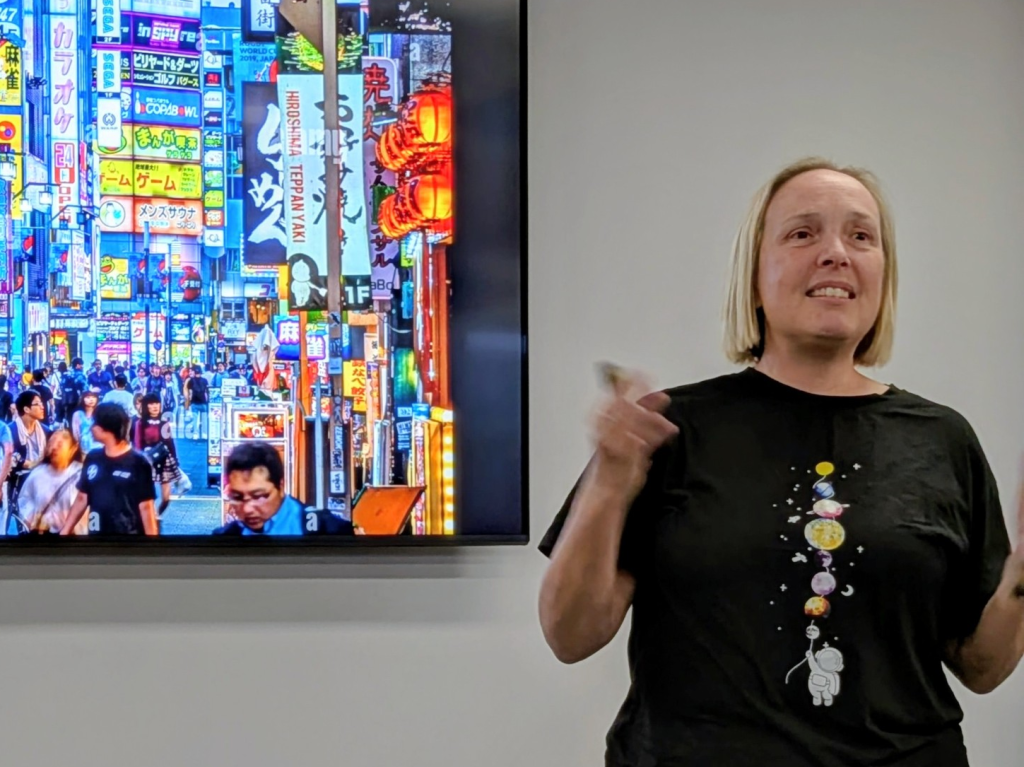
As usual, our October meeting was the annual Public Lecture and this year the topic was “The Night Is Not Lost” featuring special guest speaker, Marnie Ogg. As Founder and Director of the Australasian Dark Sky Alliance (ADSA), Marnie has worked tirelessly for many years to protect natural nightscapes via education & public awareness campaigns, advocacy with government and business, and citizen science initiatives. She was also instrumental in establishing Australia’s first Dark Sky Park in Warrumbungle National Park and the first Urban Night Sky Place at Palm Beach. Light pollution is arguably the greatest enemy of the amateur and professional astronomer but, as Marnie explained, it also has profoundly harmful effects on the environment, wildlife and human health. We are very grateful for Marnie’s wonderful, insightful presentation and wish her well in the ongoing battle for dark skies. Thanks also to John Gould and Colleen Duncan who handled the liaison and advertising; and to Frank Gross for his splendid cakes and cookies.
This Month’s Sky
The November full moon (Hunter’s Moon) falls on October 26 and the new moon will be November 9, so the first fortnight of November is the best time for dark sky observations. We have passed the September 23 equinox and we are now on Daylight Saving Time with sunset around 7.30pm and astronomical twilight ending just over one hour later. On the planets’ front, Neptune (in Pisces) and Saturn (in Cetus) are still well positioned (both setting around 4am), while Uranus is slowly making its way westward towards opposition in late November. Venus has started to head westward towards the Sun and will reach inferior conjunction on October 24, after which it will become the Morning Star until mid-2027. Constellations well positioned for dark sky observation in the early evening this month are Pegasus in the north, Aquarius and Sculptor at zenith and Indus and the Small Magellanic Cloud in the south (see November Sky for recommended dark sky objects in these constellations). Finally, October 21 marks the peak of the Orionid meteor shower (caused by the trail of Halley’s Comet) and November 3 has a lunar occultation of Jupiter visible from our part of the world.
New Members
A special welcome to new SA members Graeme, Johanna and Aprelle Todd-Richardson, and Mike and Xavier Hall.
New Facebook page
Many thanks to Colleen Duncan, our Social Media Officer, who has set up our new Facebook page entitled Shoalhaven Astronomy. We were not able to use “Astronomers” as this was restricted to the old page. Along with email messages and the SA website, this will become the third critical pillar of intraclub communication as well as a vital means of outreach to the general public. I would request that each member become a follower and invite other interested parties (family, friends, colleagues etc) to do the same.
Probus Outreach Program
One of the key strategic goals of Shoalhaven Astronomers is our educational outreach to the general community. We currently participate in the annual Science Week activities at UOW, including an observatory tour and a short talk. We have also hosted Scouts groups at the observatory for some basic stargazing. In addition to these, I recently contacted Probus groups in the Shoalhaven, Wingecarribee and Kiama regions with a view to SA offering an astronomical talk as part of their annual guest speaker schedules. The response has been quite overwhelming, with 14 groups requesting a presentation from us at some stage over the next 12 months. John Bambury will present the first talk at Jervis Bay this month.
Website Highlight
Every month we like to highlight one particular aspect of our wonderful website. This month, take a look at the top heading “Astronomical Data” which drops down to a long list of topics including “Skyview”. This opens up a very useful app known as “The Sky Live” which provides a complete star map of the northern and southern hemispheres. Its location is set for Nowra, indicating the horizon line, zenith, and cardinal directions for the sky from our part of the world. It also identifies constellations, current positions of solar system objects and many dark sky targets in the Messier or NGC catalogues.
End of Year Dinner
As per tradition, our final meeting of the year is our End of Year Dinner which will be held on Friday December 11 at Heidi’s Cafe on the UOW Nowra campus. Please note it is the second (not third) Friday of id clashing with Christmas. So far, we have a solid number of members who have responded affirmatively which is great. If anyone else intends to come along, then please contact Andrew Wood (Secretary) at amwood1961@outlook.com
Next Meeting
Our next meeting is Friday November 20. The schedule is:
- This Month’s Sky (Paul)
- Women in Astronomy (Eleanor Hewison)
- Astrophotography Display
Room change
As our membership numbers continue to grow steadily, and more visitors and guests are attending our meetings, the committee has decided to move our meeting venue to the more spacious main lecture theatre on campus. This is located in the Ray Cleary Building (300), which is two buildings to the left of our current venue.
Call for Astrophotographers
As you can see, the next meeting features our annual astrophotography display. So, if you are one of our talented astrophotographers, please gather your latest images together and bring them to the meeting (or email them to me if you can’t attend).
See you in November,
Clear skies.
Paul Gwynne
SA President